For the past few years, businesses have experimented with generative AI. Most began by deploying generic chatbots or pasting customer queries into ChatGPT.
While helpful for drafting emails, standard chatbots have hit a hard operational ceiling.
A standard chatbot is passive. It waits for human input, generates text using broad public data, and stops there. It lacks the ability to access enterprise software, update inventory, or resolve order disputes across multiple internal tools.
This limitation has sparked a major transition across global enterprises: the shift from conversational chatbots to autonomous AI agents.
Custom AI agents do not just produce answers; they achieve outcomes. When you give an AI agent an objective—such as “Qualify incoming enterprise leads, schedule product demos, and log prospect data into HubSpot”—it plans each step, accesses necessary business tools, handles unexpected errors, and completes the entire process autonomously.
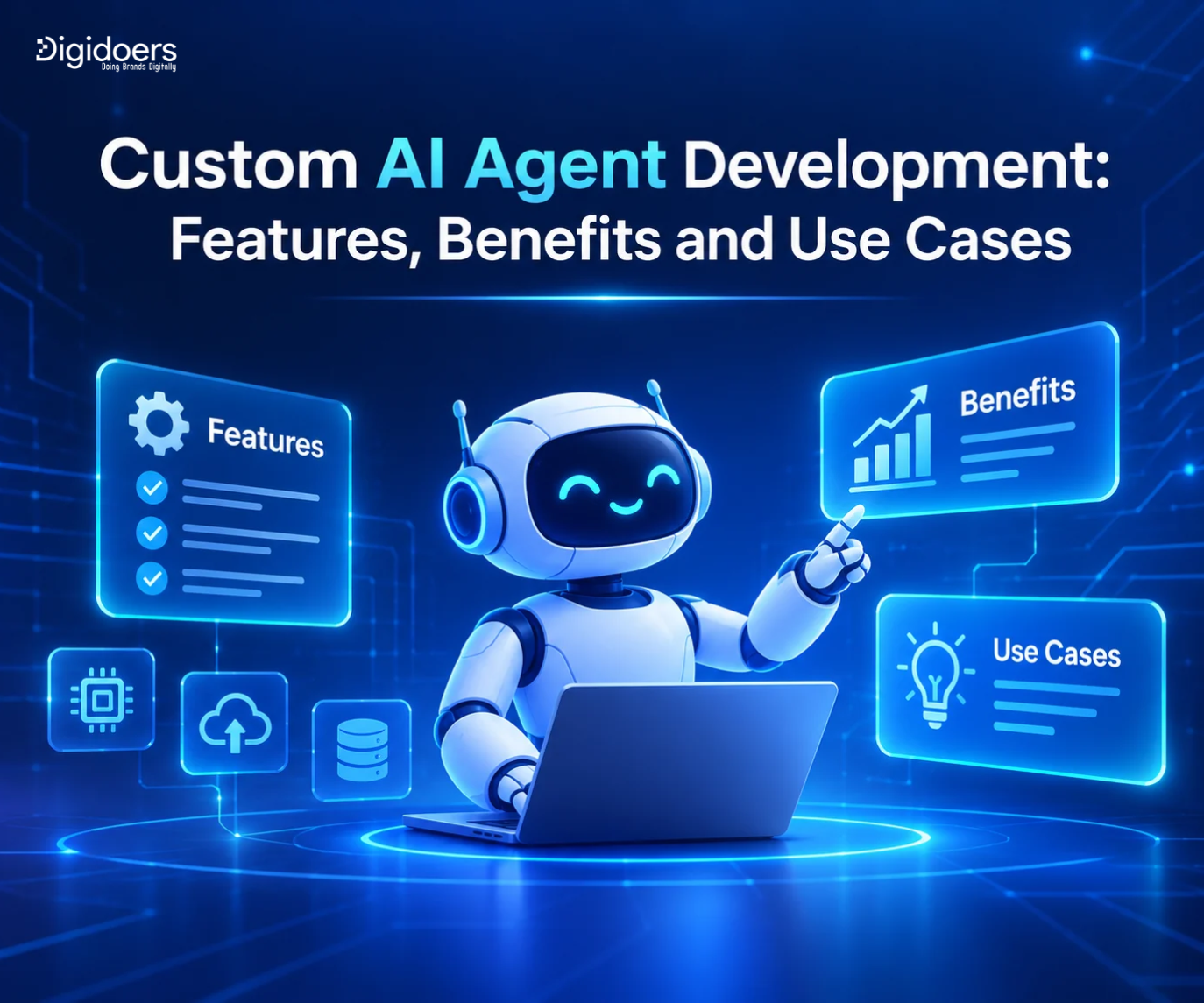
In this comprehensive guide, we unpack what custom AI agent development entails, explore the technical anatomy of an enterprise agent, evaluate its core business benefits, and explore practical industry use cases.
What Is a Custom AI Agent?
A custom AI agent is an intelligent software program engineered around advanced foundation models (such as GPT-4o, Claude 3.5 Sonnet, or open-source Llama 3 models) that possesses agency: the ability to perceive its environment, reason through problems, form a step-by-step plan, remember past context, and execute actions via external tools.
To function reliably in a business environment, an enterprise AI agent relies on five interconnected architectural pillars:
1. Perception & Context Input
The agent receives instructions from humans, system alerts, automated webhooks, or scheduled triggers. It parses unstructured inputs like emails, PDFs, voice memos, and system logs into structured machine-readable formats.
2. Reasoning & Planning Engine
Using the core LLM as a cognitive engine, the agent breaks a large goal into smaller, logical sub-tasks. It uses reasoning frameworks like ReAct (Reasoning + Acting) or Chain-of-Thought to evaluate what must happen first, what tools are needed, and how to proceed if a step fails.
3. Dynamic Memory Systems
Standard models forget context the moment a session closes. Custom AI agents feature dual memory architectures:
- Short-Term Memory: Retains current session variables and immediate interaction history.
- Long-Term Memory: Uses vector databases (like Pgvector, Pinecone, or Milvus) to recall past customer preferences, brand guidelines, and historical transaction logs.
4. Tool Execution & API Integration
This is what gives an agent true autonomy. Through secure function calling, Model Context Protocol (MCP), and RESTful APIs, the agent interacts directly with external software:
- Sending transactional emails via SendGrid.
- Querying PostgreSQL or MongoDB databases.
- Reading and updating records in Salesforce, SAP, or QuickBooks.
- Triggering payment processing workflows in Stripe.
5. Verification & Self-Correction
Before finalizing an action, the agent verifies the outcome against expected parameters. If an API call throws an error or data fails validation, the agent refines its query, tries an alternative route, or safely routes the request to a human operator.
Traditional Chatbots vs. Off-The-Shelf AI vs. Custom AI Agents
Choosing the right technology stack requires understanding how custom AI agents differ from existing solutions:
| Feature & Capability | Traditional Rule-Based Chatbots | Off-The-Shelf SaaS AI (Copilots) | Custom Enterprise AI Agents |
| Operational Autonomy | Zero; follows rigid if-then decision trees | Low; generates suggestions, awaits human click | High; independently executes multi-step tasks |
| Tool & API Calling | Limited to pre-coded, basic webhook triggers | Restricted to native vendor ecosystem | Unlimited; connects to custom backends, ERPs, and APIs |
| Data Privacy & Security | Static database storage | Data passes through shared third-party clouds | 100% private; on-premise or dedicated private cloud |
| Memory & Context | None; treats each interaction as isolated | Session-based memory only | Deep short-term and persistent long-term vector memory |
| Hallucination Risk | Not applicable (static text) | Moderate to High (relies on general training) | Very Low; grounded via Enterprise RAG on company data |
| Workflow Adaptability | Breaks when queries vary slightly | Rigid; cannot alter underlying system logic | Highly flexible; reasons through novel real-world situations |
| Total IP Ownership | Vendor-owned platform | Monthly subscription lock-in; no asset ownership | Complete source code and model ownership by your business |
Also Read: Gen AI vs Agentic AI vs AI Agents
Core Features of Enterprise-Grade Custom AI Agents
When custom-built for business operations, AI agents deliver capabilities that off-the-shelf software cannot match:
1. Autonomous Task Decomposition
Humans rarely provide instructions with every microscopic detail included. Custom AI agents excel at ambiguity. When given a high-level goal, they break it down into sequential steps, identify prerequisite data, run parallel processes, and execute systematically until the goal is achieved.
2. Domain-Specific RAG Grounding
Generic AI models often hallucinate answers when asked about complex proprietary policies. Custom agents use Retrieval-Augmented Generation (RAG). They reference your company’s live knowledge base, internal manuals, product spec sheets, and legal contracts before formulating an answer or executing an action.
3. Multi-Agent Orchestration (Swarm Intelligence)
Complex business workflows involve multiple departments. Custom architectures deploy specialized teams of agents that collaborate like human departments:
- Researcher Agent: Gathers and synthesizes market data.
- Writer Agent: Drafts personalized client communications.
- Reviewer Agent: Audits the content for compliance and accuracy.
- Coordinator Agent: Manages task distribution and deliverables.
4. Strict Human-in-the-Loop (HITL) Governance
Autonomy does not mean surrendering control. Custom agents feature configurable governance thresholds. Low-risk actions (e.g., answering customer FAQs or resetting passwords) execute instantly. High-stakes actions (e.g., approving refunds over $500 or publishing public contracts) pause and request human managerial approval.
5. Enterprise-Grade Security & Compliance
Custom development allows you to implement role-based access control (RBAC), end-to-end data encryption, and automatic PII (Personally Identifiable Information) redaction. Your proprietary data never trains public foundation models, ensuring compliance with GDPR, HIPAA, and SOC 2 Type II standards.
Business Benefits of Custom AI Agent Development
Investing in custom AI agent infrastructure yields quantifiable business returns:
1. 24/7 Scalable Operational Capacity
Human employees have physical limits. AI agents operate continuously across time zones. They handle sudden 500% traffic spikes during product launches or holiday sales without latency, fatigue, or quality degradation.
2. Dramatic Reduction in Operational Overhead
Automating repetitive workflows—such as invoice matching, data entry, email triage, and booking confirmations—frees up your senior staff to focus on high-value strategic growth. Businesses typically see a 40% to 70% decrease in manual administrative labor costs.
3. Error Elimination in Repetitive Workflows
Manual data entry between multiple systems inevitably creates human errors. A custom agent follows exact operational parameters, synchronizing CRM data, accounting software, and inventory sheets with mathematical consistency.
4. Unmatched Speed-to-Resolution
Customer satisfaction drops when clients wait hours for an email response. AI agents resolve complex customer queries in under 3 seconds—fetching account records, identifying tracking numbers, and issuing shipping updates immediately.
5. Complete Data Ownership and IP Protection
Commercial AI software providers can alter their terms, increase subscription rates, or deprecate features at will. When you engineer custom AI agents, your business owns the intellectual property, custom codebases, fine-tuned weights, and proprietary integrations permanently.
6. Frictionless Multi-System Unification
Modern businesses juggle dozens of software tools: Jira, Slack, Salesforce, Shopify, QuickBooks, and HubSpot. Custom agents act as intelligent connective tissue, allowing your systems to talk to each other without requiring manual copy-pasting.
Real-World Business Use Cases for Custom AI Agents
Custom AI agents are transforming operational efficiency across virtually every major industry sector:
1. Customer Support & Autonomous Account Management
- The Problem: Support queues get clogged with repetitive queries, leaving agents overwhelmed and customers frustrated.
- The Agent Solution: An autonomous Tier-1 support agent handles complete customer journeys. It answers questions, pulls live tracking data from logistics APIs, authorizes product exchanges within company policy, updates Shopify records, and issues replacement labels without human intervention.
- Real-World Impact: Resolves 60%+ of tier-1 support tickets instantly, slashing mean time to resolution (MTTR) from hours to seconds.
2. B2B Sales Prospecting & Lead Qualification
- The Problem: Sales reps spend over 50% of their workday researching prospects, drafting intro emails, and manually booking meetings.
- The Agent Solution: A specialized Sales Development Agent monitors website traffic, enriches prospect details using Clearbit or Apollo APIs, verifies budget fit, and conducts personalized email outreach. When a prospect expresses interest, the agent coordinates calendar availability and schedules the Zoom meeting directly.
- Real-World Impact: Doubles qualified sales pipeline volume while saving each account executive 15+ hours per week in prospecting overhead.
3. Finance, Invoicing & Reconciliation
- The Problem: Finance teams spend days manually cross-referencing supplier PDF invoices against bank statements, purchase orders, and ERP entries.
- The Agent Solution: A Financial Operations Agent ingests invoice attachments from email inboxes, uses OCR and vision models to parse line items, checks numbers against purchase orders in SAP, flags price discrepancies, and queues valid invoices for automated batch payment.
- Real-World Impact: Reduces invoice processing cycles by 85% and eliminates costly duplicate payments.
4. E-Commerce Merchandising & Dynamic Inventory
- The Problem: E-commerce stores with thousands of SKUs struggle to keep product descriptions updated, categorize attributes, and adjust pricing during competitor sales.
- The Agent Solution: A Merchandising Agent tracks supplier stock feeds, generates SEO-optimized product titles, updates tags, and adjusts dynamic pricing based on inventory levels and competitor scraping data.
- Real-World Impact: Keeps catalogs 100% synchronized and increases organic search impressions across Google AI Overviews and shopping feeds.
5. IT Helpdesk & DevOps Operations
- The Problem: Internal IT teams are bogged down by repetitive password resets, software permission grants, and server uptime monitoring.
- The Agent Solution: An IT Support Agent integrates directly into company Slack or Microsoft Teams. When an employee asks for access to a repository or reporting tool, the agent verifies their role, logs a security audit record, provisions access via Okta APIs, and notifies the team lead.
- Real-World Impact: Cuts internal IT ticket resolution times to under 60 seconds while enforcing strict security audit logs.
6. Healthcare Administration & Patient Triage
- The Problem: Medical clinics lose hours to patient scheduling, intake form verification, insurance pre-authorization, and follow-up reminders.
- The Agent Solution: A HIPAA-compliant triage agent guides patients through pre-appointment questionnaires, verifies insurance eligibility via healthcare clearinghouses, schedules appointments with the appropriate physician, and delivers personalized pre-op instructions.
- Real-World Impact: Lowers no-show rates by 35% and dramatically cuts administrative burdens on clinical staff.
How We Build Custom AI Agents?
Building a reliable, hallucination-free enterprise AI agent requires disciplined software engineering. At Digidoers, we follow a proven 5-stage lifecycle:
1: Discovery & Workflow Mapping
We analyze your operational bottlenecks. We evaluate which processes yield the highest ROI when automated and define clear boundaries, success metrics, and security requirements.
2: Private Knowledge Base & RAG Pipeline Setup
We structure your unstructured company assets (SOPs, documentation, historical tickets, database tables) into a secure, low-latency vector database. We ensure sensitive data is tokenized and protected.
3: Agent Engineering, Tool Selection & Guardrails
We configure reasoning frameworks using industry-standard tools (LangChain, LlamaIndex, LangGraph, or custom Python/Node.js backends). We implement strict guardrails to prevent hallucinations, enforce response constraints, and establish human-in-the-loop review triggers.
4: API Integration & System Connectivity
We securely wire the agent into your production tech stack—connecting your CRM (HubSpot, Salesforce), ERP (SAP, NetSuite), communications tools (Slack, Teams, WhatsApp), and custom relational databases.
5: Rigorous Testing, Deployment & Continuous Optimization
We run simulated edge-case testing, latency evaluations, and adversarial red-teaming. Once deployed on dedicated private cloud infrastructure (AWS, Google Cloud, or Azure), we track execution metrics, monitor token consumption, and fine-tune model parameters for ongoing performance gains.
Common Pitfalls to Avoid in AI Agent Development
Before embarking on your AI journey, be mindful of these critical development traps:
- Attempting to Automate Everything at Once: Trying to build a single “god agent” that handles marketing, accounting, and development causes reasoning errors. Focus on specific, modular agents that master one domain before connecting them into a collaborative network.
- Neglecting Data Quality: An AI agent is only as good as the data it accesses. Outdated PDFs and contradictory company documentation produce unreliable outputs. Clean your knowledge base before building RAG pipelines.
- Skipping Human Oversight: Releasing completely autonomous agents into public-facing environments without guardrails is risky. Always implement confidence scoring; if an agent’s confidence drops below 85%, route the request to a human.
- Ignoring API Rate Limits & Token Costs: Poorly optimized agent loops can trigger runaway API calls, resulting in unexpected cloud bills. Use efficient caching, small specialized models for routine sub-tasks, and strict maximum execution limits.
Final Thoughts
Artificial intelligence is evolving at an unprecedented pace. In 2026 and beyond, the companies dominating their industries will not be the ones with the largest manual workforces. They will be the businesses that pair their human talent with custom, autonomous AI agent infrastructure.
Generic AI tools offer basic speed-ups. Custom AI agents create compounding competitive moats. By automating complex operational loops, connecting isolated software stacks, and operating around the clock, custom agents transform how modern companies scale.
The question for business leaders is no longer “Can AI help our business?” The real question is: “Which operational workflows will we automate with custom AI agents before our competitors do?”
Frequently Asked Questions
Q: What is the difference between an AI chatbot and a custom AI agent?
A: A traditional chatbot is passive and text-based; it only answers questions using pre-defined scripts or general knowledge. A custom AI agent is autonomous; it understands goals, breaks tasks into steps, queries enterprise databases, and directly executes actions across external software (like creating CRM records or processing invoices) without manual human prompting.
Q: Will our company’s proprietary data be safe when using custom AI agents?
A: Yes. When building custom enterprise AI agents with Digidoers, your proprietary data is hosted in private vector databases and isolated cloud environments (AWS, GCP, Azure). We utilize enterprise API agreements that guarantee your data is encrypted in transit and at rest, and is never used to train public foundation models.
Q: What technologies are used in custom AI agent development?
A: Modern AI agent development utilizes foundation models (OpenAI GPT-4o, Anthropic Claude 3.5 Sonnet, Meta Llama 3), orchestration frameworks (LangChain, LangGraph, LlamaIndex, CrewAI), vector databases (Pgvector, Pinecone, Qdrant), backend environments (Python, FastAPI, Node.js, Laravel), and tool protocols like REST APIs and the Model Context Protocol (MCP).
Q: Can custom AI agents replace human employees?
A: No. Custom AI agents are designed to augment human workforces, not replace them. They take over time-consuming, repetitive, low-value administrative tasks—like data entry, invoice checking, and routine status updates—allowing your team members to focus on high-impact strategic, creative, and client-facing initiatives.