
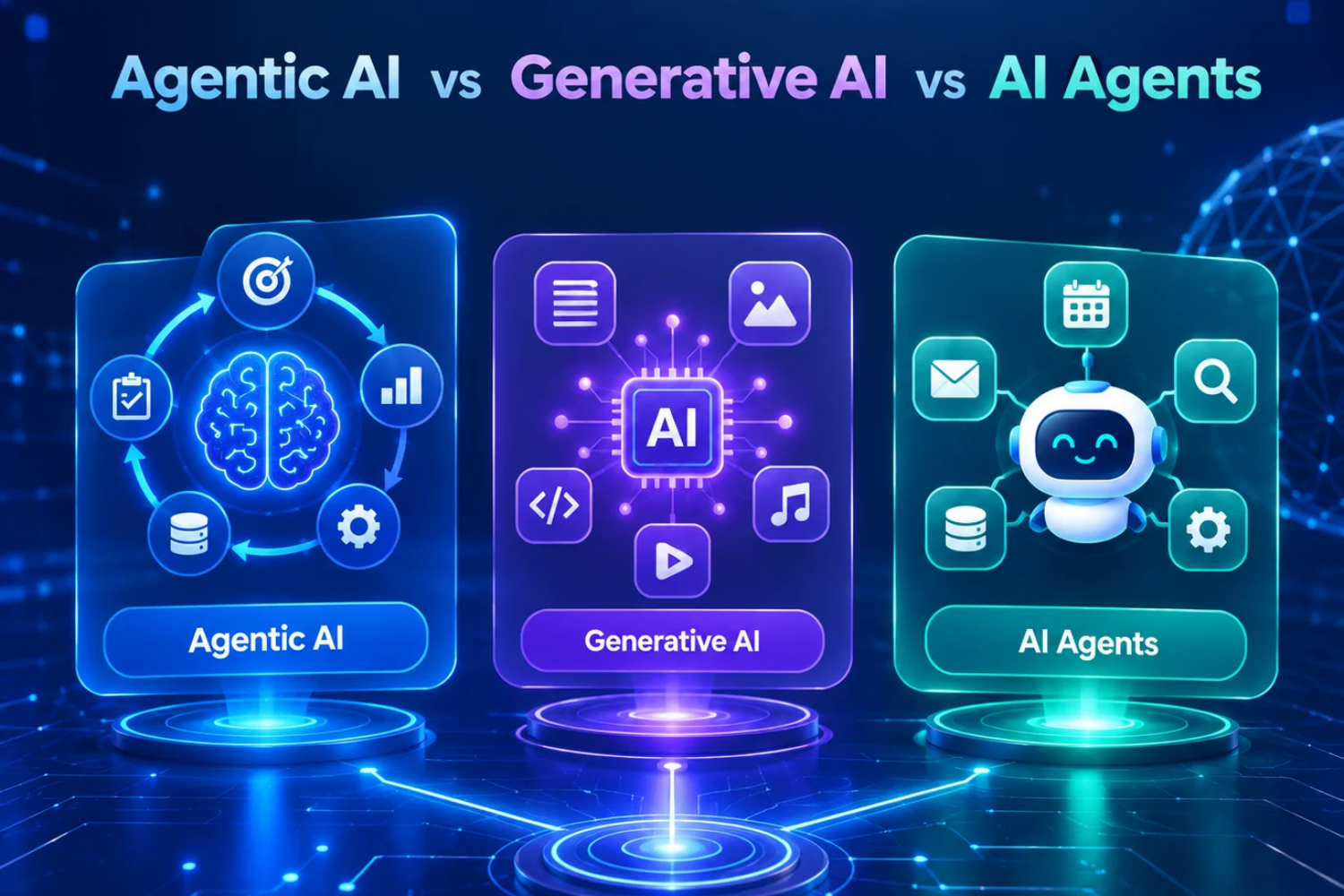
Artificial intelligence is helping businesses automate tasks, improve customer experiences, and make better-informed decisions. However, as AI technology evolves, choosing the right solution can be confusing. What is the difference between Generative AI, AI agents, and Agentic AI? And which one is best for your business?
Generative AI creates content, AI agents perform tasks using AI and connected tools, and Agentic AI focuses on achieving broader goals through planning and multi-step execution. These technologies can work together to automate business processes, improve productivity, and reduce manual work.
For example, a marketing team can use Generative AI to create content, an AI agent to qualify leads and update a CRM, and an Agentic AI workflow to coordinate a larger sales process.
The right choice depends on your business goals, workflow complexity, data access, and the level of automation you need.
What Is Generative AI?
Generative AI is a type of artificial intelligence that creates new content from prompts, instructions, and available context. It can generate text, images, code, audio, video, summaries, and other forms of digital content.
Generative AI models learn patterns from training data and use those patterns to produce relevant outputs. Some applications can also retrieve information from connected sources to provide more context-aware responses.
How Does Generative AI Work?
Generative AI receives a prompt, processes the request, and generates an output based on the model and the information available to it.
For example, an ecommerce development business can use Generative AI to create product descriptions, write promotional emails, and summarize customer feedback. Employees can then review and refine the output before publishing it.
By reducing repetitive content-related work, Generative AI helps teams spend more time on strategy, quality control, and customer relationships.
Common Business Use Cases of Generative AI
Businesses use Generative AI for:
- Content marketing: Create blog drafts, product descriptions, social media posts, and email campaigns.
- Customer support: Draft responses, summarize conversations, and answer knowledge-based questions.
- Software development: Generate code, explain technical issues, and assist with debugging.
- Business reporting: Summarize documents, explain data trends, and prepare report drafts.
- Sales enablement: Create proposals, personalized outreach messages, and sales presentations.
- Internal knowledge management: Help employees understand policies and find relevant information.
When should your business use Generative AI?
Choose Generative AI when your primary goal is to create, summarize, or transform information. It is a practical starting point for businesses that want to improve employee productivity without immediately automating complex workflows.
Read Also: How Generative AI Will Transform Web Development?
What Are AI Agents?
AI agents are software systems that use AI to perform assigned tasks, often by accessing data, selecting actions, and interacting with external tools or applications.
Unlike a basic chatbot that primarily generates responses, an AI agent can take action within its permitted environment. Depending on its configuration, it might retrieve customer information, update a CRM record, schedule a meeting, or process a support request.
AI agents can range from simple, instruction-driven systems to more advanced systems that choose tools and adjust their next steps based on results.
How Do AI Agents Work?
An AI agent typically follows a task-oriented process:
- Receive a task: Understand an instruction or triggering event.
- Gather information: Retrieve relevant data from approved sources.
- Select an action: Determine the next step based on the task and available information.
- Execute the task: Use an API, business application, or connected tool.
- Check the result: Confirm completion or determine whether another action is needed.
The exact workflow depends on the agent’s design, permissions, and level of autonomy.
Common Business Use Cases of AI Agents
AI agents can help businesses automate specific operational tasks, including:
- Sales automation: Qualify leads, retrieve account details, and prepare follow-up activities.
- Customer service: Categorize support tickets, find relevant policies, and assist with routine resolutions.
- Ecommerce operations: Retrieve order statuses, check product information, and support returns workflows.
- Human resources: Answer employee questions and coordinate onboarding activities.
- IT support: Classify incidents, collect diagnostic information, and initiate approved troubleshooting steps.
- Finance operations: Extract invoice information, validate fields, and route documents for approval.
When should your business use AI agents?
Choose AI agents when you need AI to perform a specific task rather than simply generate an answer. They are especially useful when a task requires access to business systems, structured information, or repeatable actions.
For example, a sales agent could review incoming leads, apply qualification criteria, update the CRM, and create follow-up tasks for the sales team.
What Is Agentic AI?
Agentic AI refers to AI systems designed to pursue a defined objective by planning actions, using tools, evaluating results, and adapting their approach as work progresses.
Instead of completing only one assigned task, an Agentic AI system can coordinate multiple tasks toward a broader business outcome. It may combine AI models, software tools, business rules, and multiple AI agents to manage a workflow.
The terminology is still evolving. AI agents and Agentic AI are sometimes used interchangeably, but a useful distinction is that an AI agent is a task-performing component, while Agentic AI describes broader goal-oriented behavior or a system built around that behavior.
How Does Agentic AI Work?
An Agentic AI workflow generally involves these steps:
- Understand the goal: Identify the desired outcome and applicable constraints.
- Create a plan: Break the goal into smaller tasks and determine their sequence.
- Gather information: Access relevant business data and connected applications.
- Execute actions: Complete tasks using approved tools or coordinate specialized agents.
- Evaluate progress: Check whether the actions are producing the expected results.
- Adapt or escalate: Adjust the plan when necessary or request human intervention.
For example, an Agentic AI system supporting customer onboarding could identify missing documents, initiate approved verification steps, update customer records, and route exceptions to the appropriate employee.
Its actual capabilities depend on the underlying technology, integrations, permissions, and safeguards. Agentic AI does not automatically guarantee independent or error-free decision-making.
Common Business Use Cases of Agentic AI
Agentic AI can support complex, multi-step workflows such as:
- Customer onboarding: Coordinate document collection, verification, account setup, and approvals.
- Sales operations: Research prospects, prepare outreach, update CRM records, and coordinate follow-ups.
- Supply chain management: Monitor inventory, evaluate replenishment needs, and prepare purchase orders for review.
- Customer service operations: Investigate issues across connected systems and coordinate resolution steps.
- Business research: Gather information, compare findings, and prepare structured reports.
- IT operations: Investigate alerts, collect diagnostic evidence, and coordinate approved remediation steps.
When should your business use Agentic AI?
Consider Agentic AI when your business needs to coordinate several connected tasks toward a specific outcome. It is particularly relevant when workflows involve conditional decisions, multiple applications, changing information, and ongoing progress checks.
Because these systems can perform more complex actions, they also require stronger testing, monitoring, access controls, and human oversight.
Agentic AI vs Generative AI vs AI Agents: Key Difference
The main difference lies in what each technology is designed to accomplish.
| Feature | Generative AI | AI Agents | Agentic AI |
| Primary purpose | Create or transform content | Perform assigned tasks | Achieve broader goals through multiple steps |
| Input | Prompt or source material | Task, instruction, or event | Goal, context, and constraints |
| Typical output | Content, code, summaries, or insights | Completed action or task result | Coordinated workflow outcome |
| Planning | Usually focused on the requested output | Task-level planning, depending on design | Broader planning and adaptation |
| Tool usage | Optional | Often uses APIs and connected tools | Coordinates tools, tasks, and potentially multiple agents |
| Autonomy | Usually prompt-driven | Depends on configuration | Goal-oriented, within defined limits |
| Business example | Draft a customer email | Retrieve order details and update a ticket | Coordinate an order-issue resolution workflow |
| Best suited for | Content and knowledge tasks | Specific operational tasks | Complex, multi-step processes |
These technologies are complementary rather than mutually exclusive. An AI agent can use a Generative AI model, and an Agentic AI workflow can coordinate several agents to achieve a larger objective.
Real-World Example: How Do All Three Work Together?
Consider an ecommerce business that wants to reduce the time spent resolving delayed-order inquiries.
Generative AI: Creates a clear customer response using verified order information and company communication guidelines.
AI agent: Retrieves the latest order and shipping status, checks the relevant record, and updates the support ticket or prepares an approved response.
Agentic AI: Coordinates the broader resolution workflow by checking delivery information, applying escalation rules, initiating an approved carrier inquiry, and routing unresolved cases to a support representative.
In this example, Generative AI creates the response, the AI agent performs specific actions, and Agentic AI coordinates the wider process.
This combined approach can help businesses automate more of the customer journey without treating every task as a separate, disconnected workflow.
Which AI Technology Is Best for Your Business?
The best AI solution depends on your business objectives and the complexity of the work you want to automate.
Choose Generative AI for Content and Knowledge Tasks
Generative AI is a suitable option if your team spends considerable time creating content, summarizing reports, drafting emails, or answering information-based questions.
Example: A marketing team uses AI to prepare blog drafts, product descriptions, and campaign ideas for human review.
Choose AI Agents for Specific Task Automation
AI agents are suitable when a process requires AI to retrieve information, interact with software, or complete a defined task.
Example: A sales team uses an agent to qualify leads, update CRM records, and schedule follow-up activities based on predefined criteria.
Choose Agentic AI for Complex Workflow Automation
Agentic AI is worth considering when multiple tasks and applications must work together to achieve a broader objective.
Example: An operations team uses an Agentic AI workflow to coordinate onboarding across document management, verification, CRM, and approval systems.
Can Your Business Use All Three?
Yes. Many businesses can benefit from combining Generative AI, AI agents, and Agentic AI.
A practical strategy is to start with content generation or a clearly defined task, measure the results, and then introduce broader workflow automation where it offers additional value.
How to Choose the Right AI Solution?
Before implementing AI, consider these five factors.
- Define the business objective. Identify whether you want to create content faster, automate a repetitive task, reduce processing delays, or coordinate an entire workflow.
- Assess workflow complexity. A simple summarization task may only need Generative AI. Tasks involving system access and defined actions may need an agent. Multi-step processes with dependencies may benefit from Agentic AI.
- Check data and integration requirements. Determine which systems the solution must access, such as your CRM, ERP, ecommerce platform, database, or customer support software.
- Set autonomy and security limits. Define which actions AI can perform independently and which require human approval. Use appropriate access controls, monitoring, and audit logs, particularly for sensitive or high-impact actions.
- Measure business results. Track time saved, cost per task, error rates, resolution times, successful task completion, and the amount of human intervention required.
Start with a limited pilot, compare its performance with the existing process, and expand only when the results justify the investment.
Challenges of AI Implementation and How to Overcome Them
Although AI can improve business efficiency, implementing it successfully requires careful planning. Businesses may face challenges related to system integration, data quality, security, cost, and employee adoption. Addressing these issues early can help organizations reduce risks and achieve better results from their AI investments.
– Integration complexity: Connecting AI solutions with existing software may require APIs, workflow changes, and data preparation.
How to address it: Start with essential integrations, test compatibility, and expand gradually.
– Accuracy and reliability: AI systems can generate incorrect information or take inappropriate actions.
How to address it: Test outputs, validate results, monitor performance, and require human review for critical decisions.
– Data security and privacy: AI systems may access sensitive business or customer information.
How to address it: Apply role-based access controls, data protection policies, and clear rules for handling sensitive information.
– Cost and maintenance: AI implementation may involve mobile app and web development, infrastructure, integration, and ongoing monitoring costs.
How to address it: Begin with a focused pilot, define a budget, and measure return on investment before scaling.
– Governance and accountability: Automated decisions can create risks if responsibilities and approval processes are unclear.
How to address it: Establish usage policies, maintain audit logs, define escalation procedures, and set limits on autonomous actions.
– Employee adoption: Teams may be uncertain about using AI or adapting their existing workflows.
How to address it: Provide practical training, explain how AI supports employees, and involve relevant teams during implementation.
Final Thoughts
Generative AI, AI agents, and Agentic AI offer different ways to improve business productivity and automation.
Generative AI creates content and transforms information. AI agents perform assigned tasks using AI and connected tools. Agentic AI coordinates multiple steps to work toward a broader goal.
Which one should your business choose? Start with Generative AI for content and knowledge work, use AI agents for defined operational tasks, and consider Agentic AI when you need to coordinate complex workflows across multiple systems.
The goal is not to adopt the most advanced technology. It is to select the solution that addresses a real business need, delivers measurable value, and maintains the right balance between automation, accuracy, and human control.
Frequently Asked Questions
1. What is the difference between Agentic AI and Generative AI?
Generative AI creates content or transforms information. Agentic AI focuses on achieving a goal through planning, tool use, multiple actions, and progress evaluation. Agentic AI systems may use Generative AI models as part of their workflows.
2. Are AI agents and Agentic AI the same thing?
Not exactly. An AI agent performs tasks using AI and potentially connected tools. Agentic AI generally describes broader goal-oriented behavior that coordinates actions and adapts a workflow to achieve an objective. The terms can overlap depending on the system.
3. Can Generative AI work as an AI agent?
Yes. A Generative AI model can be integrated into an AI agent alongside tools, instructions, and execution logic. This allows the larger system to interpret requests, retrieve information, and perform permitted actions.
4. Which is better for business automation: AI agents or Agentic AI?
AI agents are often suitable for specific tasks, such as updating records or classifying requests. Agentic AI may be more suitable when multiple tasks must be coordinated toward a larger outcome. The right choice depends on complexity, risk, and integration needs.
5. Can small businesses use Agentic AI?
Yes. Small businesses can explore Agentic AI for suitable workflows, including customer support coordination, lead follow-ups, and routine administration. A limited pilot with clear objectives and permissions can help control cost and risk.
6. Does Agentic AI require Generative AI?
No. Agentic AI can use different AI models, rule-based systems, and software tools. However, many modern Agentic AI systems use Generative AI models to interpret instructions, reason about tasks, and generate content.
7. How should a business start implementing AI?
Identify a repetitive or time-consuming business problem, select the simplest technology that can address it, and test it on a limited scale. Evaluate accuracy, cost, security, and business outcomes before expanding the implementation.